Three Pillars of the Platform
The front end draws out the truth, the back end turns it into a basis for decisions, and the governance rules make people willing to speak. Drop any one of the three and the interview comes back empty.
Conversational Interview Engine
One open question at a time, pushing vague statements down to a specific time, place and step in the process.
Learn about the interview engineStructured Analysis and Action Plans
What you get is a converged document covering what to do first, why that item, and where it is stuck, not a stack of transcripts.
Learn about structured analysisRespondent Protection and Permission Governance
Tiered permissions and a minimum-headcount threshold are system behavior, not project promises, which is why staff speak frankly.
Learn about respondent protectionConversational Interview Engine
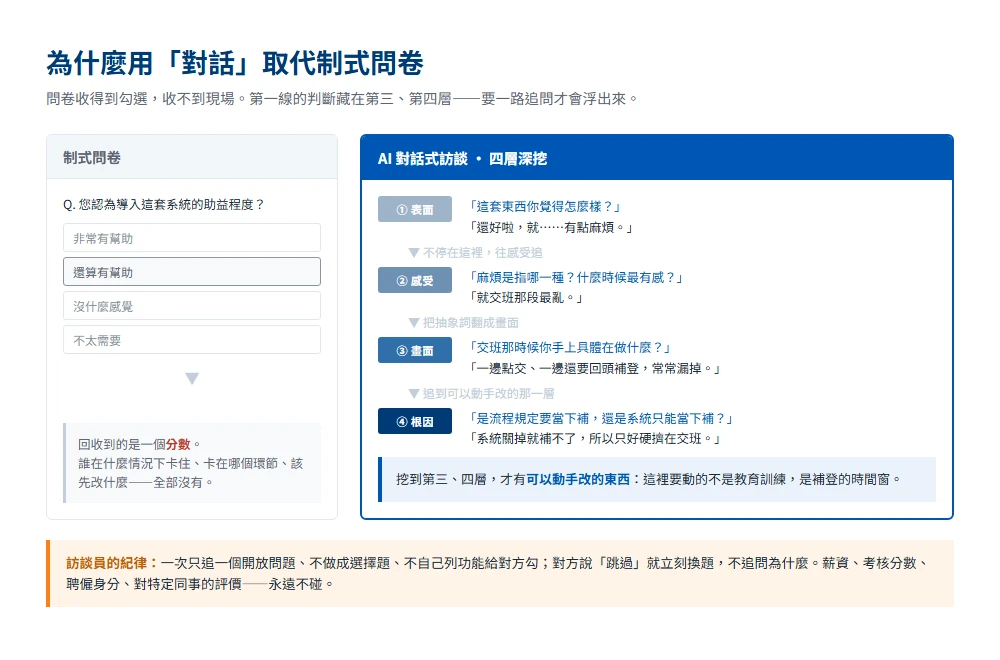
A standard questionnaire collects checkboxes, not what happens on the ground. The AI interviewer spends 10–15 minutes with frontline staff on their phone, follows whatever they say, and pushes vague phrases such as "it's a hassle" or "that would probably help" down to which incident, which step and which process was actually running.
Technical Highlights
- Four-layer probing: from the surface statement to the feeling, to a concrete scene, and on to the process or policy root cause behind it
- No multiple-choice questions and no pre-written feature checklist to tick, so the answer is never handed to the respondent
- Depth adapts to the role level the respondent selects: frontline staff talk about what the work actually feels like, managers talk about priorities and cross-department handoffs
- Say "skip" and the interviewer moves to the next question at once, with no follow-up on why and no repeated request
- Explicitly avoids pay and bonuses, performance scores, employment status, and personal judgments of specific colleagues
- Conversations can be paused and resumed; the interviewer remembers what was already covered and does not ask twice
Use Cases
- Gathering frontline input before a new service or system is rolled out
- Mapping adoption resistance after rollout: which part of the process is actually stuck
- Auditing perception gaps between departments
- Collecting evidence of need before a tender, a grant application or an internal proposal
Structured Analysis and Action Plans
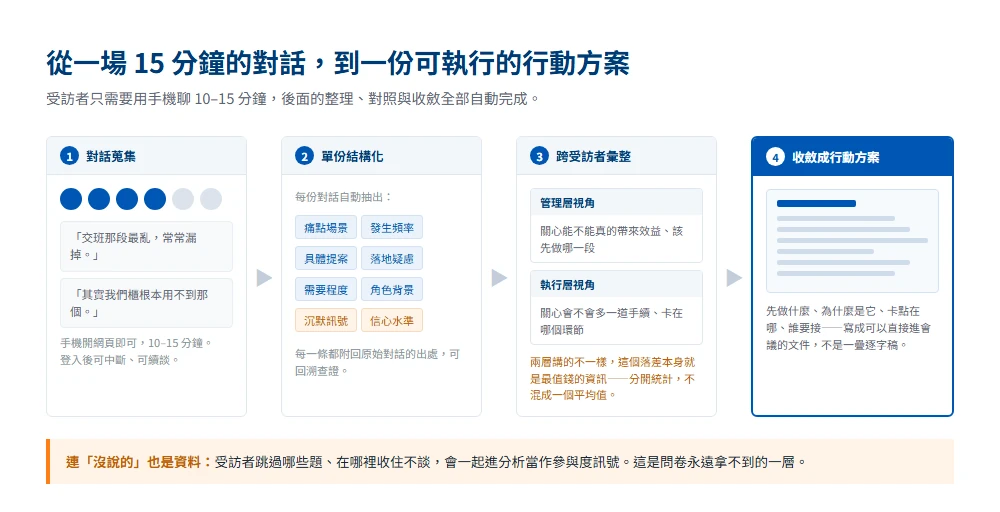
The interview does not end with a transcript dropped back on your desk. Each conversation is automatically distilled into pain-point situations, concrete proposals, adoption concerns and level of need; those are aggregated across respondents and converged into an action plan that states what to do first, why that item, where it is stuck and who has to own it.
Technical Highlights
- Every interview produces structured fields: pain-point situation and how often it occurs, concrete proposals, category of adoption concern, level of need, and role background
- Every conclusion carries a reference back to the original conversation, so each judgment you read can be traced and checked
- Silence counts as signal: which questions were skipped and where someone stopped short are both recorded as engagement clues
- Figures are broken out by role level rather than averaging managers and frontline staff into one number, because the gap between them is itself a finding
- Each analysis is labeled with a confidence level, so thin samples are never written up as settled conclusions
- Action plans and live conversation use separately configured models and reasoning budgets; the delivered document is generated with the stronger configuration
Use Cases
- You need a converged document you can take straight into a management meeting, not raw interview records
- You want to know how far management's picture is from what actually happens on the ground
- You need a basis for ranking project priorities and committing resources
Respondent Protection and Permission Governance
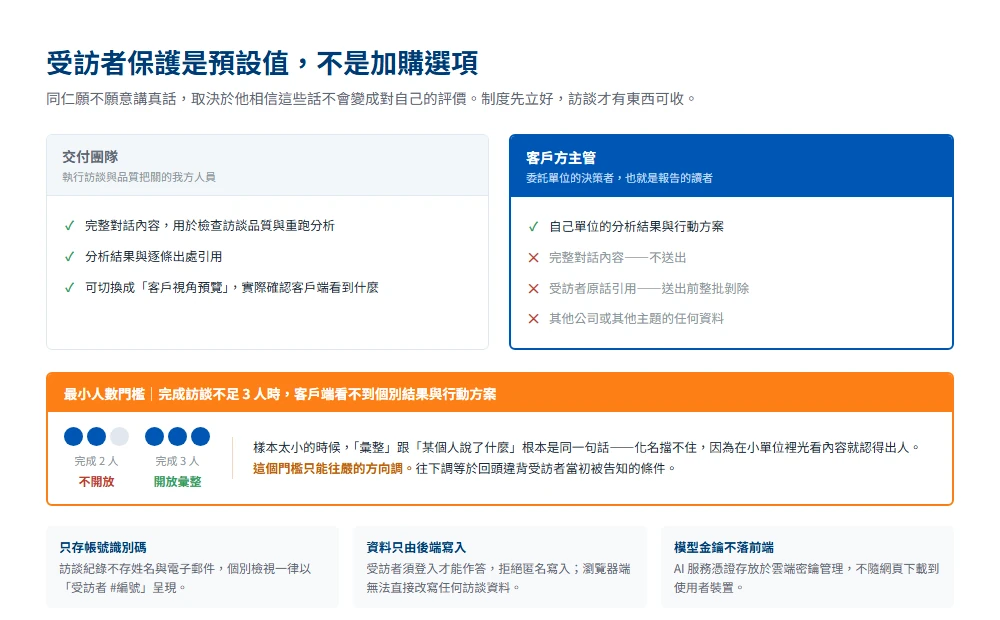
Whether staff speak frankly depends on their believing that what they say will not turn into a judgment of them. We built the protection into system behavior: who can see which data, and what is blocked when there are too few respondents, are decided by code, not by a verbal promise made during the project.
Technical Highlights
- Two administrator tiers: the delivery team can read full conversations for quality control, while managers on the client side see only the analysis, with full conversations and verbatim quotes stripped out in bulk before delivery
- Minimum headcount threshold: with fewer than 3 completed interviews the client sees neither individual results nor the action plan, because at that sample size "the aggregate" and "what one person said" are the same sentence
- The threshold can only be tightened; loosening it would retroactively break the terms respondents were told at the outset
- Interview records keep only an account identifier, never names or email addresses, and individual views are labeled "Respondent #number"
- Respondents must sign in to answer and anonymous writes are rejected; interview data is written only by the back end and cannot be altered from the browser
- The delivery team can switch to a client-view preview that re-renders the whole page under client permissions, confirming exactly what the client sees
- AI service credentials are held in cloud secret management and are never downloaded to the user's device with the page
Use Cases
- Internal interviews that touch on what employees really think, including concerns about the system itself
- Projects run by an outside team where the client still has to read the conclusions
- Situations where respondents have to be told in concrete terms where their data goes and how it is protected
One Configuration File Is One New Topic
The platform uses a two-level tenant structure (company to interview topic). A new topic needs no change to the engine, so setup time goes into getting the interview script right instead of rewriting the system.
All Settings in One File
The interview script, the analysis dimensions, the action-plan format and the copy on the respondent login page all live in a single configuration. The engine itself is untouched: change the configuration and you change the topic.
Parallel Topics, Isolated Data
One company can run several interview topics at the same time, and neither the interviews nor the analyses are visible across them. Client administrators can add or revoke accounts directly in the console with no redeployment.
Nothing to Install for Respondents
Respondents answer by opening a web page on their phone and signing in, with no app to install and no accounts to hand out. The platform is deployed in production and runs several topic configurations at once.
A dedicated edition exists for healthcare venues: AINav Clinical Navigation applies the same interview methodology to quantifying nurse retention intent and turnover risk.
Want to Know What Is Really Stuck on the Front Line?
The interview script, the analysis dimensions and the action-plan format are all redesigned around your topic. Before we start we confirm two things with you: what respondents will be told, and what your side will end up reading.
Get in Touch